To all our friends and family,
We’ve been in Africa for 4 months today. It’s about time for another begging letter…. so here goes.
We are working at a hospital in the remote rural community of Ishaka. At any time we have 4 or 5 children on the ward with severe malnutrition. They are all under 5 years old, some are babies as young as 6 months. Some are HIV positive, some are just unlucky enough to be born to very, very poor families. Without proper treatment half of these children are currently dying.
This situation is particularly uncomfortable for us. In the UK we treat patients for free, often for illnesses which arise from excess (smoking, drinking, eating). In Uganda we have to charge the poor for treatment of the diseases of poverty. The charges are low by UK standards, but are simply unaffordable to most Ugandans. More than 50% of the population live on less than $1 a day here. So parents often take their children home before they are better tosave money.
Ideally, we would like the children to stay in hospital for a week, to be fed with high energy milk and be given vitamin supplements, immunisations and antibiotics. This costs £10 and reduces the mortality rate to less than 10%. We would also like to send them home with a mosquito net, a bag of high energy soya and some multivitamins. This would cost another £3.50.
We are setting up a trust fund at the hospital. It would cover the cost of this treatment so that when malnourished children are admitted they are offered the full weeks treatment package for free. The hospital is corruption free and the treasurer would give us regular accounts of how the money is spent. We can continue to deposit money into the trust fund after leaving.
Will you help us do this? Please email me if you feel you can. Thanks.
jan.power@rosmellyn.cornwall.nhs.uk
Wednesday, January 24, 2007

Tuesday, January 23, 2007
Bridesmaids Dresses

Gender can be tricky here. Children are often dressed in what can only be described as bridesmaids dresses. They’re beautiful. Ivory or pink satin, chiffon and lots of bows. My guess is they start as ‘Sunday Best’ and as they get tatty or outgrown are worn all the time. Worn by whomever they fit best, although I admit I’ve never seen one on a boy above 2 or 3. In Runyankore she and he are not differentiated, so no clues there either. Names? Well, sometimes helpful but not always. Robert – always male (so far), Annet (ditto female). But its not always that obvious. Polly was male, as was Pauline. And Johnson was female. And some names give no clues at all. Immaculate, Chance, Admire and Generous, I’m just left guessing…..
Sunday, January 14, 2007
Ka Wareba


“Ka wareba” means “I’m sorry for your troubles”. It’s used when people die or when you’re breaking really bad news. I’d just seen a woman with a threatened miscarriage in outpatients, to be told by Jeffrey the medical student sitting in with me that in those circumstances ka wareba would not be appropriate. Its use would imply that the situation is hopeless and that the baby was already dead. He explained that it used to be said when people were diagnosed with HIV (here the disease is called ‘silimu’ because of the weight loss associated with AIDS) but that now ka wareba is no longer appropriate. With routine prophylaxis for opportunistic infections, and with ARV treatment people can live a healthy and positive life after diagnosis. It seems to be perfectly OK to ask people if they’ve had syphilis, or been treated for it recently. Syphilis is startlingly common and probably even overdiagnosed. I don’t bat an eyelid asking anyone about it, mothers about whether their children have been tested, priests etc. They expect to be asked and don’t mind being tested at all, or so it seems. It’s not unusual for someone to have tested positive for syphilis or gonorrhoea but not even thought about HIV testing. However, as soon as I follow up the syphilis question with the inevitable (to me) question about HIV testing, the staff roll their eyes and look embarrassed, and the patient shifts about uncomfortably as though I’ve committed a terrible faux pas and accused them of loose morals. Many people diagnosed still don’t disclose their condition to friends or family. There’s clearly a stigma and an understandable fear attached to the diagnosis.
Despite the church and politicians banging on all the time about abstinence, sex is everywhere here. Family planning is rarely used, large families are the norm, infidelity is common and polygamy is not unusual. Two days ago I saw a prepubertal 12 year old boy with full blown gonorrhoea. I’ve seen 2 people this week who have waited until they are dangerously ill with AIDS before coming for testing and treatment.
With our everyday experiences we’re still not really sure how Uganda has achieved its remarkably low HIV prevalence of about 6% (down from around 30% in the early 90s). There are plenty of billboards everywhere encouraging testing and access to ARVs is improving all the time. Unlike in many other African countries at least there has been a political will from the outset not to ignore or, worse still, to deny the crisis. Health education has focused on the ABC programme of Abstinence, Be faithful and use Condoms.
Last Friday 10 prisoners from the local jail pitched up to outpatients in their stripey yellow pyjamas and chains. 9 of them had syphilis so we are trying to get a team of 30 healthworkers together to go into the prison on the 9th feb to screen all 528 for syphilis and hiv......
The pictures are of the outpatient department at Ishaka Hospital, and snaps from the local Queen Elizabeth gamepark (half an hour and a wonderful drive down into the rift valley away) of a colobus monkey and a kob probably the most ubiquitous of the antelopes around here.
The pictures are of the outpatient department at Ishaka Hospital, and snaps from the local Queen Elizabeth gamepark (half an hour and a wonderful drive down into the rift valley away) of a colobus monkey and a kob probably the most ubiquitous of the antelopes around here.
Tuesday, January 09, 2007
Mpangos and porters

Whilst walking up Mount Elgon there was plenty of time to think. Strange juxtaposition of lives. We were paying our porters £2.50 a day to carry our heavy rucksacks (sometimes on their heads), fetch water for us, wash up our things, and (so I was reassured) carry us back down the mountain in the event of us injuring ourselves. I felt a mixture of emotions. Guilt, obviously. Yet they were delighted to have the work. And our guide was going to get his first Christmas day off in 8 years as we were coming down Christmas Eve and he would have to spend Christmas Day ‘washing his uniform’. Any food we left over they promptly ate. And of course there was the opportunity, never to be missed by a Ugandan, to talk politics.
Sitting round a bonfire one night at 3500m with 15 young Ugandan men was a privilege (we were sharing the tin shack with a party of 11 path clearers). They were faultlessly polite and helpful. They dried our wet clothes, made us tea, cooked our strange food for us (rice and a packet curry – not bad actually). From black carrier bags they’d carried up the mountain they produced dried beans, onions, dodo (a sort of small leafed spinach), a cabbage, three tomatoes, curry powder and ghee, and proceeded to cook a nutritious meal from scratch.
In the countryside if you pass a male older than 3 they will be carrying a machete (mpango / panga). It’s a multipurpose tool. I was reminded of the Rosmellyn awayday where we had to think of as many things as possible to do with an item from our handbags. (for those of you who were there, remember the credit card – to remind yourself of your name, guess the number on long car journeys, for self defence, go for the throat…)
Things I have seen one used for.
to chop wood
to cut a walking stick
to hack yourself a path through dense vegetation
as a strimmer
as a lawnmower
to finely shred cabbage/dice an onion
as a toaster
as a walking stick
as a poker
as a chisel (furniture making)
as a plane (furniture making)
unfortunately as a weapon. We all know about the horrific events in Rwanda in 1994 when many of the 800,000 killed were butchered with machetes. One of my first mornings here on the ward in Ishaka was spent trying to sort out a 12 year old who had been attacked with a machete by her 16 year old brother and badly wounded. It had happened 12 hours earlier, no-one seemed to know why. He was in police custody but she had had to wait until daybreak, when her stepmother persuaded the village elder to bring her to the hospital (no-one had any money). She was badly injured, cold, and terrified. We had no blood for transfusion, so after resuscitating her, cleaning her up and assessing her wounds we packed her off to Mbarara (in a taxi!) in the vain hope that she might see an orthopaedic surgeon who may be able to save her right hand….
Sitting round a bonfire one night at 3500m with 15 young Ugandan men was a privilege (we were sharing the tin shack with a party of 11 path clearers). They were faultlessly polite and helpful. They dried our wet clothes, made us tea, cooked our strange food for us (rice and a packet curry – not bad actually). From black carrier bags they’d carried up the mountain they produced dried beans, onions, dodo (a sort of small leafed spinach), a cabbage, three tomatoes, curry powder and ghee, and proceeded to cook a nutritious meal from scratch.
In the countryside if you pass a male older than 3 they will be carrying a machete (mpango / panga). It’s a multipurpose tool. I was reminded of the Rosmellyn awayday where we had to think of as many things as possible to do with an item from our handbags. (for those of you who were there, remember the credit card – to remind yourself of your name, guess the number on long car journeys, for self defence, go for the throat…)
Things I have seen one used for.
to chop wood
to cut a walking stick
to hack yourself a path through dense vegetation
as a strimmer
as a lawnmower
to finely shred cabbage/dice an onion
as a toaster
as a walking stick
as a poker
as a chisel (furniture making)
as a plane (furniture making)
unfortunately as a weapon. We all know about the horrific events in Rwanda in 1994 when many of the 800,000 killed were butchered with machetes. One of my first mornings here on the ward in Ishaka was spent trying to sort out a 12 year old who had been attacked with a machete by her 16 year old brother and badly wounded. It had happened 12 hours earlier, no-one seemed to know why. He was in police custody but she had had to wait until daybreak, when her stepmother persuaded the village elder to bring her to the hospital (no-one had any money). She was badly injured, cold, and terrified. We had no blood for transfusion, so after resuscitating her, cleaning her up and assessing her wounds we packed her off to Mbarara (in a taxi!) in the vain hope that she might see an orthopaedic surgeon who may be able to save her right hand….
Wednesday, January 03, 2007
Living with Matoke


We packed up and left Mbarara yesterday having to hire a pick-up to move just 3 months worth of accumulated "stuff". Our new home is a bungalow within the Ishaka Hospital compound with magnificent views towards distant hills and the sunset in the west. The Hospital compound occupies an entire hill with the accommodation at the crest and the wards, outpatient department, nursing school and lab technician training school lower down. There is a bustling trading centre outside the gates and a private university with attached brand new teaching hospital being constructed down the road. Our responsibilities for the next couple of months are to look after the medical wards and the outpatient department, and we'll be supported by two Philippino Missionary doctors , one an obstetrician, the other a general surgeon.
Our garden is a permacultural feast with papayas, avocados, and matoke trees. Matokes are the plantains that have been the staple carbohydrate in Uganda for the last 2000 years. Perennial, low maintenance, high calorie and easy to cook they are the ideal food crop and the whole of south-west Uganda is a patchwork of homesteads with attendant Matoke plantations. We have 2 big bunches almost ready to harvest.......
Friday, December 29, 2006
Semliki


Two days exploring the Albertine Rift Valley, part of a 1200m deep 40 km wide depression running down the eastern border of Uganda into Rwanda, Tanzania and Malawi, caused by the separation of two huge tectonic plates.
We drove down a dramatic cliff-hugging dirt road into the savannah grassland below. Two luxury nights in a remote safari lodge , with game drives ( kob, kob, warthogs, buffalow and more kob.) Game numbers are beginning to increase again after they were decimated (for food) in the war years. We didn't see the elephants - we'll save those for a visit to Murchison Falls. We had a long morning's walk through dense riverine forest tracking one of three groups of chimpazees who we watched for 20 minutes chewing on the sugary pulp of palm fronds.
Packing up tomorrow. New Years Eve away with friends and then a new job on Tuesday - a two month attachment as Medical Officers in the District Hospital at Ishaka.
Tuesday, December 26, 2006
Christmas hols on Mount Elgon


We treated ourselves to a hike on Mount Elgon after a weeks job hunting. Our plans are still unresolved but we're hoping to work as jobbing Medical Officers in a rural district hospital for a couple of months and then move up to Kampala. We were very impressed by Mbuya Reachout, a church sponsored HIV project, in one of Kampala's poorest parishes. They have worked extremely hard over the last 5 years to encourage HIV testing , starting people on ARVs and providing psychological, social and economic support for people with HIV and their families. There is impressive community support for the project with a lot of volunteering and the whole place had a buzz about it. I hope we can set something up with them - our placement Manager at VSO in Kampala, Sarah Kyobe, has been very supportive.
Mount Elgon on Uganda’s eastern border with Kenya is one of Africas free standing volcanoes ( like Kilimanjaro and Mount Kenya), covers the largest surface area of any such volcano, and rises to 4321m. It’s a national park and we took a four day tour, with guides (Rogers and Abel)and porters (Fred and Bosco). The landscape is beautiful and unspoilt, the vegetation changing as you increase in altitude from bamboo and mountain forest to alpine moorland. The latter reminded us strongly of the peaks (on steroids) and walks on Derwent edge though of course everything - the hills, the heathers and the flowers are bigger and more exotic. The first nights campsite is shown in the picture - a huge bat filled cavern with a waterfall streaming down over its entrance. The walking was steady and not overly demanding though we both suffered the effects of altitude when we got to the top - feeling very sick and headachey. This got suddenly and dramatically better as soon as we descended to 3000m.
For Christmas we went back to the Haven, the beautiful campsite overlooking the Nile just north of lake Victoria at Jinja. Wonderfully relaxing and a welcome opportunity to lose ourselves in some novels. We’re still waiting to find out about jobs and have yet to compose our letter of resignation to the University of Mbarara........
Mount Elgon on Uganda’s eastern border with Kenya is one of Africas free standing volcanoes ( like Kilimanjaro and Mount Kenya), covers the largest surface area of any such volcano, and rises to 4321m. It’s a national park and we took a four day tour, with guides (Rogers and Abel)and porters (Fred and Bosco). The landscape is beautiful and unspoilt, the vegetation changing as you increase in altitude from bamboo and mountain forest to alpine moorland. The latter reminded us strongly of the peaks (on steroids) and walks on Derwent edge though of course everything - the hills, the heathers and the flowers are bigger and more exotic. The first nights campsite is shown in the picture - a huge bat filled cavern with a waterfall streaming down over its entrance. The walking was steady and not overly demanding though we both suffered the effects of altitude when we got to the top - feeling very sick and headachey. This got suddenly and dramatically better as soon as we descended to 3000m.
For Christmas we went back to the Haven, the beautiful campsite overlooking the Nile just north of lake Victoria at Jinja. Wonderfully relaxing and a welcome opportunity to lose ourselves in some novels. We’re still waiting to find out about jobs and have yet to compose our letter of resignation to the University of Mbarara........
Tuesday, December 12, 2006
Job crisis and indecision

Nearly 3 months in and it looks like we've run out of work here. We've submitted a proposal for an academic department of Family Medicine and are waiting for the University and Ministry of Health to respond. They need to make financial commitments to the training and employment of generalist Medical Officers who can provide medical and surgical care in the rural level 4 Health Centres. This is all actually ministry policy but Museveni promised everyone the earth before the elections in February and it is now clear that spending on health is frozen at least until the next election looms in 2011. As we've said before health spending is 3.5% of GDP and a fraction of what is necessary to run even a basic service.
We are also submitting a proposal to the Dean and Hospital Chief Executive on Thursday for a Clinical Department of Family Medicine to take managerial responsibility for the very busy Outpatient Department here. This one doesnt really need funding just a commitment to change in an organisation that is resistant to change. The outpatient department is a chaotic, anarchic and riotous mass of bodies in all stages of ill health. There is no overall manager below the hospital chief executive and the staff come and go pretty much as they please. Government wages are low (£30 pcm for a nurse aid, £100 for a registered nurse, £150 for a clinical officer (physicians assistant grade) and £200 for a Medical Officer. Nobody can run an average sized Ugandan family and pay school fees without moonlighting in at least one other job and all the medical officers and clinical officers have a substantial private practice that takes them away from their government commitments. Understandably they're not keen on a couple of muzungus waltzing in and expecting some commitment to timekeeping.
So, effectively we've done a needs assessment and feel like nothing else is likely to happen here for at least a few months. We've asked VSO to give us details of other job opportunities and will be touring around looking at the options over the next week or so. We have a comfy social life here so a move feels difficult but we need to get our teeth into something more substantial so we'll see.........
The outpatient department is the building on the right in this picture. The crowds have taken cover from the torrential downpour. It feels like the rainy season has just finished with no rain for several days now. The next one is March to May.
Proposal for a clinical department of Family Medicine
PROPOSAL FOR THE DEPARTMENT OF FAMILY MEDICINE TO TAKE OVER THE MANAGEMENT OF THE OUTPATIENT DEPARTMENT
CURRENT CHALLENGES
The outpatient department has 19 clinical staff members and performs a vital function in administering care to approximately 100,000 attenders each year. Its efficiency is impaired by a number of factors:
Lack of leadership
There is an identified senior management team but no leadership. There are no departmental or management meetings and as a consequence the department does not work as a team. Some of the staff members’ attendance and time keeping is poor.
Lack of systems
There are no protocols or guidelines for patient management.
There is no drug formulary.
There is no system for the ordering of stock.
Lack of training
There is no attention to service development.
There is no regular in-house staff training.
Prescribing knowledge is largely driven by the pharmaceutical industry.
Inadequate finances
There is no discrete budget for the department.
Pharmacy stock is inadequate for the demand.
Poor relationships with other departments
Not all outpatient attenders are seen each day and the overflow arrives directly at the wards.
Referrals to other departments are perceived as being too high.
There is no coordination or planning with other departments.
There is no coordination or planning with the wider community
Many staff members seem opposed to change.
On the positive side:
There is adequate infrastructure.
Many staff members are very experienced and capable.
Some staff members would welcome attention to organisational development.
PROPOSAL
The Department of Family Medicine and Community Practice should assume managerial control of the Outpatient Department in order to;
Provide leadership
Monitor the service, campaign for budget increases and explore limited cost sharing schemes
Introduce a drug formulary for outpatients and improve drug ordering systems and supply
Contribute to the clinical workforce (minimum 2 lecturers)
Provide an organisational development role with regular team meetings and in-service training
Develop protocols and guidelines with particular attention to rational prescribing and appropriate referral
Introduce audit as a routine tool for the development and improvement of the service
Create an environment for clinical research
Provide a teaching environment for undergraduate and postgraduate students of all disciplines
Liaise with other departments and specialties
Liaise with community health facilities to improve patient flow and management
Jan Power and Mark Russell. December 2006
CURRENT CHALLENGES
The outpatient department has 19 clinical staff members and performs a vital function in administering care to approximately 100,000 attenders each year. Its efficiency is impaired by a number of factors:
Lack of leadership
There is an identified senior management team but no leadership. There are no departmental or management meetings and as a consequence the department does not work as a team. Some of the staff members’ attendance and time keeping is poor.
Lack of systems
There are no protocols or guidelines for patient management.
There is no drug formulary.
There is no system for the ordering of stock.
Lack of training
There is no attention to service development.
There is no regular in-house staff training.
Prescribing knowledge is largely driven by the pharmaceutical industry.
Inadequate finances
There is no discrete budget for the department.
Pharmacy stock is inadequate for the demand.
Poor relationships with other departments
Not all outpatient attenders are seen each day and the overflow arrives directly at the wards.
Referrals to other departments are perceived as being too high.
There is no coordination or planning with other departments.
There is no coordination or planning with the wider community
Many staff members seem opposed to change.
On the positive side:
There is adequate infrastructure.
Many staff members are very experienced and capable.
Some staff members would welcome attention to organisational development.
PROPOSAL
The Department of Family Medicine and Community Practice should assume managerial control of the Outpatient Department in order to;
Provide leadership
Monitor the service, campaign for budget increases and explore limited cost sharing schemes
Introduce a drug formulary for outpatients and improve drug ordering systems and supply
Contribute to the clinical workforce (minimum 2 lecturers)
Provide an organisational development role with regular team meetings and in-service training
Develop protocols and guidelines with particular attention to rational prescribing and appropriate referral
Introduce audit as a routine tool for the development and improvement of the service
Create an environment for clinical research
Provide a teaching environment for undergraduate and postgraduate students of all disciplines
Liaise with other departments and specialties
Liaise with community health facilities to improve patient flow and management
Jan Power and Mark Russell. December 2006
Sunday, December 10, 2006
Rwanda


A fleeting weekend visit to Rwanda with our friend Sylvia. Down to Kigali first to visit the Genocide museum - a harrowing but well done presentation of the grim reality of 1994. Then a scenic drive north west to lake Kivu for a couple of days of sightseeing. The countryside is spectacular - the land of a thousand hills. Steep hilly country with densely cultivated terraces and in the distance the mountains and volcanoes on the border with the Congo and Uganda. As we explored the countryside we immersed ourselves in books about the history and the multitude explanations for how neighbours turned on neighbours in a frenzy of killing.
The church in Kibuye was the site of the massacre of nearly 12000 Tutsis who had taken refuge from the Hutu mobs. First they chucked in grenades then they went in with machetes. It took 4 hours to kill everybody..... Only 1000 out of the 50,000 Tutsis in this district survived.
It's amazing now that there is stability and a sense of progress though its still a desperately poor country with many challenges . We will visit again. We want to find out more about the reconciliation process and what mechanisms are in place to prevent a relapse into violence.
Interestingly, we had good tarmac to the border of Rwanda then hit appalling potholed dirt in Uganda. The customs officer had gone for lunch so all the cross border travellers congregated impatiently until the customs officer rolled back completely pissed an hour later. In the queue a Ugandan woman working in Rwanda said Rwanda is making rapid progress. We asked why? She said because unlike in Uganda there is no corruption. Tarmac has been promised on the Ugandan side since 1986........
Thursday, November 30, 2006
A nerds tour of local health centres

We've just finished our fact finding tour of local health facilities and are left with an overwhelming mix of feelings. There just isn't enough money in the system so with a few notable exceptions such as Kitagata last week most health centres just don't get enough funding to function effectively for more than part of the time. Undersized budgets mean that even if the staff complement is good drugs run out 2 weeks into each month.
Kitwe HC4 is an hour down a dirt road, off the main road from Ntungamo. It has a good range of buildings, staff accommodation even a fully equipped operating theatre. But with no medical officer and no anaesthetist the theatre has been unused since it was built 5 years ago. Even when there was a medical officer in post a couple of years ago they are often new graduates and don't have the confidence to keep up a surgical practice. With no electricity, no running water and not much to do in the evenings it's hard to keep doctors there for any length of time. The team seemed bright and capable and were really trying to provide a good service. It's hard to see how they can stay optimistic in the face of their difficulties though. They had 2 clinical officers, 4 midwives 4 nurses , 3 nurse aides and a bunch of support staff.
Ruhama HC2 is a tiny enterprise started by a Ugandan in his old family house. Again, a good team, poor facilities but big ideas. Unfortunately it is less than 2 miles from a government health centre and the two seem to be in competition rather than collaborating to improve health outcomes. Why the NGOs and missionary outfits don't ever get involved in running and improving existing services I really don't understand. The Ruhama enterprise was interesting in its efforts to generate income locally to help fund the service. The running costs of $750 pcm which provided a nurse, 2 nurse aides, a lab technician , a finance officer and support staff were met 1/3 from user fees for medicines, 1/3 from the parent NGO and 1/3 from a variety of local projects. These included eucalyptus plantations to provide firewood for sale, a stone quarry and beekeeping enterprise as well as a savings and credit scheme. Addressing income in impoverished rural areas is vital.
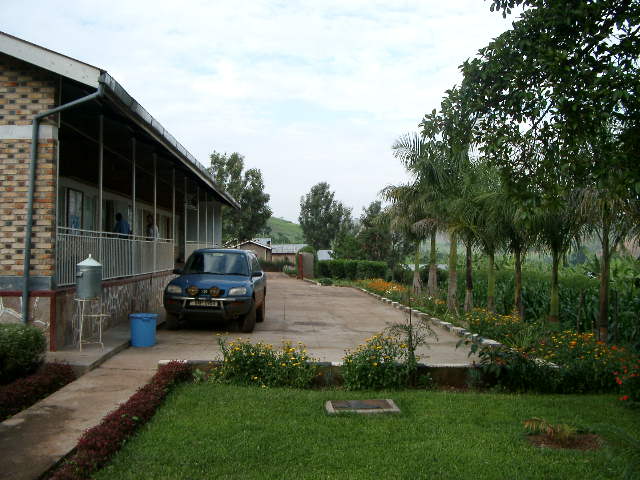
Our third visit of the day was to a HC2 run by brazilian nuns. The 20 minutes down a very rough dirt road gave no hint of the splendour of the unit. From being almost impassable the road gave out to a wrought iron gate in a crafted stone wall worthy of a Hollywood mansion. The concrete driveway flanked by luscious palms led through a manicured but productive garden to a gleamingly clean and welcoming purpose built health centre. The quietly spoken and determined nun seemed to have sorted the ideal arrangement. She had persuaded the district to give the centre its own budget which amounted to $500 pcm, which they spent on drugs. They then sell the drugs and lab tests at cost and use that money to pay staff wages (the nuns come free, they employ an additional nurse, a clerk, a lab technician and household support staff). Oh and she keeps a firm grip on all the keys so none of the stock disappears. The place was beautifully kept with plenty of welcoming posters and messages on the walls and doors. Enough to make you believe in God (or nuns at least).
Our final visit was to Rugarama HC4 in Kabale. Another splendid example of a mission based health unit, operating semi independently of the district but with a government budget. Well staffed and efficiently run, it was clearly delivering a high standard of care compared with the government hospital up the road, but again was charging user fees and there seemed to be no communication between the two units. The Ministry of Health Grant of $4000 pcm paid the wages of almost 80 staff. There were consultation fees inpatient charges and drugs and lab tests were charged at cost. Capital costs are met by donations usually from the International Lions organisation. They are hoping to start obstetric surgery soon and want to build a paediatric unit to allow the maternity unit to expand. They need to build more staff accommodation as providing accommodation is the only way to make their salaries competitive with government ones. Nurses are on $150 pcm, clinical officers on $250 and docs on $500.
We've done with visiting! It's been great to see so many examples of good and not so good practice, the challenges faced by overwhelmed government units and the contrast with better resourced private ones.
We're both left unsure about the whole business of user fees. Coming from the UK it goes against the grain to charge people at all for health care, let alone the really poor for treatment of diseases of poverty. But at least with the brazilian set up the charges were as low as they could be and were posted on the wall so people knew what was being charged for. We heard stories in government centres of parents having to go to a drug shop to buy the syringe and needle for their child to get the injection of antimalarials they desperately needed because the hospital had run out, and that isn't right either.
Kitwe HC4 is an hour down a dirt road, off the main road from Ntungamo. It has a good range of buildings, staff accommodation even a fully equipped operating theatre. But with no medical officer and no anaesthetist the theatre has been unused since it was built 5 years ago. Even when there was a medical officer in post a couple of years ago they are often new graduates and don't have the confidence to keep up a surgical practice. With no electricity, no running water and not much to do in the evenings it's hard to keep doctors there for any length of time. The team seemed bright and capable and were really trying to provide a good service. It's hard to see how they can stay optimistic in the face of their difficulties though. They had 2 clinical officers, 4 midwives 4 nurses , 3 nurse aides and a bunch of support staff.
Ruhama HC2 is a tiny enterprise started by a Ugandan in his old family house. Again, a good team, poor facilities but big ideas. Unfortunately it is less than 2 miles from a government health centre and the two seem to be in competition rather than collaborating to improve health outcomes. Why the NGOs and missionary outfits don't ever get involved in running and improving existing services I really don't understand. The Ruhama enterprise was interesting in its efforts to generate income locally to help fund the service. The running costs of $750 pcm which provided a nurse, 2 nurse aides, a lab technician , a finance officer and support staff were met 1/3 from user fees for medicines, 1/3 from the parent NGO and 1/3 from a variety of local projects. These included eucalyptus plantations to provide firewood for sale, a stone quarry and beekeeping enterprise as well as a savings and credit scheme. Addressing income in impoverished rural areas is vital.
Our third visit of the day was to a HC2 run by brazilian nuns. The 20 minutes down a very rough dirt road gave no hint of the splendour of the unit. From being almost impassable the road gave out to a wrought iron gate in a crafted stone wall worthy of a Hollywood mansion. The concrete driveway flanked by luscious palms led through a manicured but productive garden to a gleamingly clean and welcoming purpose built health centre. The quietly spoken and determined nun seemed to have sorted the ideal arrangement. She had persuaded the district to give the centre its own budget which amounted to $500 pcm, which they spent on drugs. They then sell the drugs and lab tests at cost and use that money to pay staff wages (the nuns come free, they employ an additional nurse, a clerk, a lab technician and household support staff). Oh and she keeps a firm grip on all the keys so none of the stock disappears. The place was beautifully kept with plenty of welcoming posters and messages on the walls and doors. Enough to make you believe in God (or nuns at least).
Our final visit was to Rugarama HC4 in Kabale. Another splendid example of a mission based health unit, operating semi independently of the district but with a government budget. Well staffed and efficiently run, it was clearly delivering a high standard of care compared with the government hospital up the road, but again was charging user fees and there seemed to be no communication between the two units. The Ministry of Health Grant of $4000 pcm paid the wages of almost 80 staff. There were consultation fees inpatient charges and drugs and lab tests were charged at cost. Capital costs are met by donations usually from the International Lions organisation. They are hoping to start obstetric surgery soon and want to build a paediatric unit to allow the maternity unit to expand. They need to build more staff accommodation as providing accommodation is the only way to make their salaries competitive with government ones. Nurses are on $150 pcm, clinical officers on $250 and docs on $500.
We've done with visiting! It's been great to see so many examples of good and not so good practice, the challenges faced by overwhelmed government units and the contrast with better resourced private ones.
We're both left unsure about the whole business of user fees. Coming from the UK it goes against the grain to charge people at all for health care, let alone the really poor for treatment of diseases of poverty. But at least with the brazilian set up the charges were as low as they could be and were posted on the wall so people knew what was being charged for. We heard stories in government centres of parents having to go to a drug shop to buy the syringe and needle for their child to get the injection of antimalarials they desperately needed because the hospital had run out, and that isn't right either.
I'm reminded again of Paul's concern about the investment in hospital facilities and the relative neglect of simple preventative measures that attend to clean water, sanitation, decent housing, enough to eat, vaccinations and malaria prevention all of which would save many lives.....
Sunday, November 26, 2006
Mad dogs and muzungus
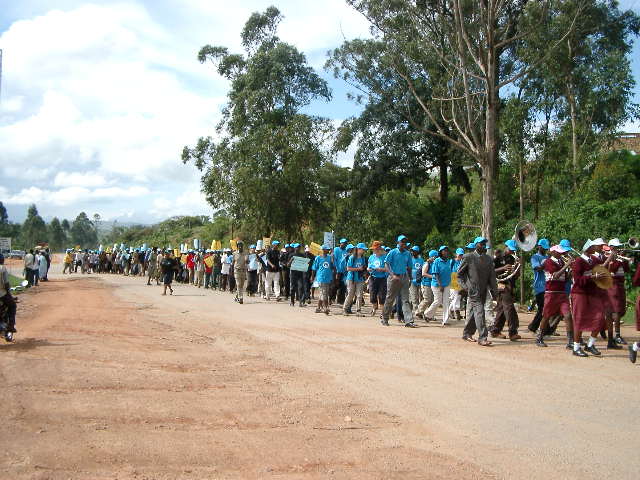


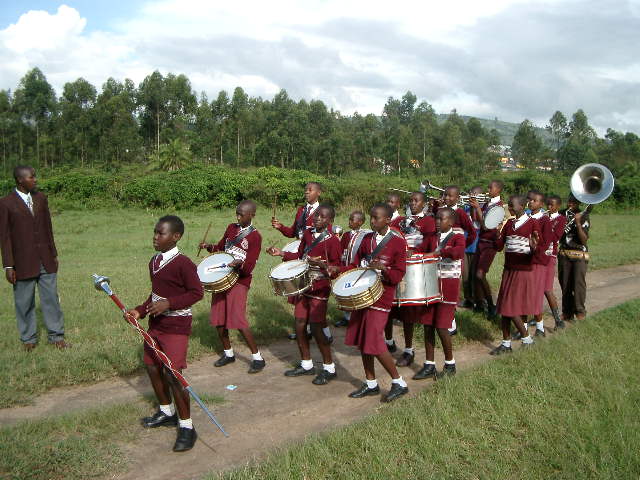
Saturday we pitched up in Ntungamo to support Frouke's fundraising walk. Frouke is a Dutch VSO working for an NGO that supports a level 2 health centre (clinic + 1 nurse, 2 nurse aides + 1 lab tech) in Ruhama. Our carload of Muzungus from Mbarara arrived promptly for a 7am start. The childrens marching band arrived at 10 and the lorry load of walkers from Ruhama at1030. We've been relatively protected from Uganda time so far (though I have so far made 6 fruitless visits to the Ugandan revenue authority in an attempt to register the ownership of my car). It was a scenic walk in good company for the 25km to Ruhama through hamlets surrounded by matoke plantations and fields of beans, maize and sweet potato. We started off en masse behind the band in Ntungamo and when the band quit after 20 minutes the masses disappeared over the horizon in an extraordinary show of athleticism. (In fact there was a huge amount of scepticism about whether the soft muzungus would be able to complete the walk). For the last third I was in the company of (and struggling to keep up with) 2 teenagers including the streetwise Abdel, a 10 year old in barefeet sporting an umbrella, her mother and aunt both carrying babies and wearing flipflops and her grandmother holding an m&s bag containing her groceries. M
It turned out to be the most eventful sponsored walk I've ever been on. We marched around the small town of Ntungamo led by the 'chief walker' and in formation 3 abreast behind the banner and childrens band. People carrying home made posters in English and Runyankore with messages urging immunisation, safe sex and regular deworming. My favourite was the child walking along proudly holding aloft his poster reading 'participants register here'.
After 2 or 3 km Francis, the NGO director and event organiser fell heavily whilst running to catch up with the leading group and had an obvious fracture of his left arm. He was sweaty and in pain but after a makeshift sling and a couple of ibuprofen got up and hurried on. When I caught up with him near the end of the walk he told me they had a very good traditional healer at the health centre who would sort him out when he got there. He continued to lead from the front and finished the walk before coming over a bit queasy again and agreeing to come with us back into town for an xray and plaster of paris. The xray confirmed the fracture, and the POP, bought in a local pharmacy and applied by a Belgian medical student (with my inexpert help) looked a bit scruffy but seemed to do the trick.
We retired for barbecued maize, chapati, beer and aftersun....J
It turned out to be the most eventful sponsored walk I've ever been on. We marched around the small town of Ntungamo led by the 'chief walker' and in formation 3 abreast behind the banner and childrens band. People carrying home made posters in English and Runyankore with messages urging immunisation, safe sex and regular deworming. My favourite was the child walking along proudly holding aloft his poster reading 'participants register here'.
After 2 or 3 km Francis, the NGO director and event organiser fell heavily whilst running to catch up with the leading group and had an obvious fracture of his left arm. He was sweaty and in pain but after a makeshift sling and a couple of ibuprofen got up and hurried on. When I caught up with him near the end of the walk he told me they had a very good traditional healer at the health centre who would sort him out when he got there. He continued to lead from the front and finished the walk before coming over a bit queasy again and agreeing to come with us back into town for an xray and plaster of paris. The xray confirmed the fracture, and the POP, bought in a local pharmacy and applied by a Belgian medical student (with my inexpert help) looked a bit scruffy but seemed to do the trick.
We retired for barbecued maize, chapati, beer and aftersun....J
Wednesday, November 22, 2006
Kitagata noodle parlour
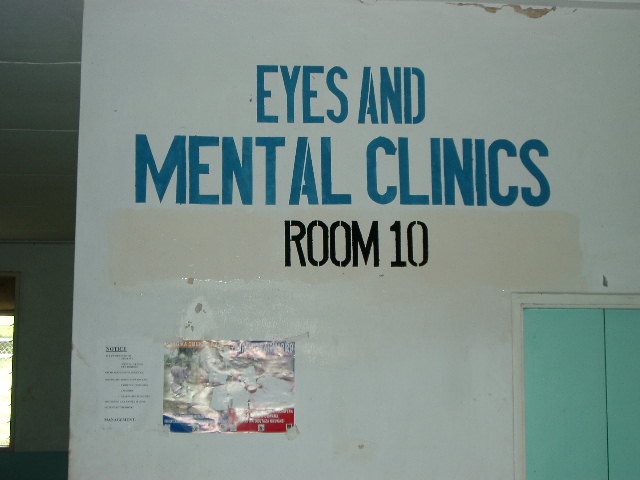
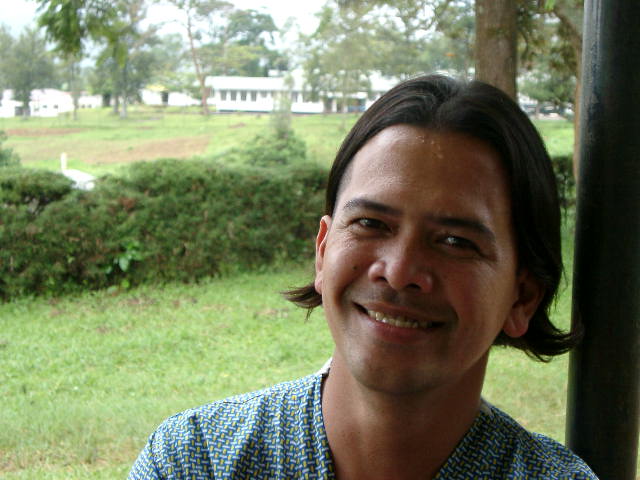
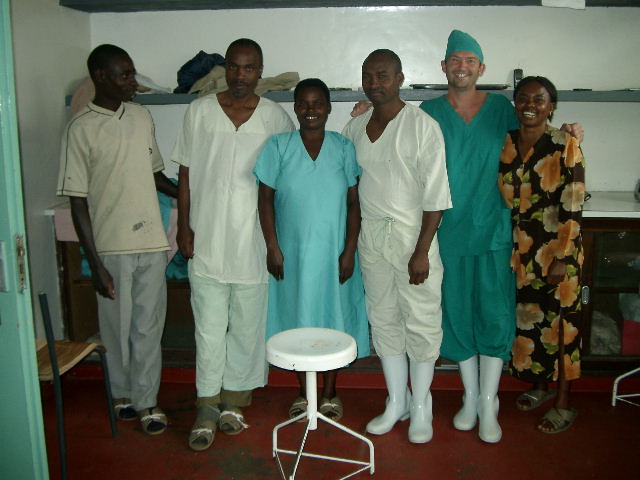
We've just had a couple of good days visiting Allan Sande at the district hospital in Kitagata, an hour and a half west of us. Allan's a VSO GP from the Philipines who's been in post for exactly a year - a proper old fashioned GP probably quite capable of doing appendicectomies and caesarian sections on the kitchen table. He's one of 4 docs in the hospital and does literally a bit of everything. Not only did we have a fun time being cooked for and looked after by Allan (the Kitagata noodle parlour!) but he is a wonderful mix of funny, outrageous, kind, wise and plain sensible. Kitagata is a single dirt track of a town with open shop fronts just like in the cowboy films. We embarrassed ourselves playing pool with an audience of 60 Ugandans ( in varying states of sobriety) but were warmly greeted by everyone.
Allan's enjoying Kitagata, and its easy to see why. Kitagata Hospital works!! There are reasonable staffing levels, the pharmacy has nearly all its essential drugs nearly all of the time, and it can cope with most of the problems people present it with. This is very unlike our experience of all the other government health units we've come across so far. The consensus seems to be that it works is because of effective leadership. Wilber has been medical superindent for 5 years. There is no obvious corruption here. A good job is done by capable people at all levels of staff and morale seems high. An important lesson.
I remember one of Alastair's important ingredients for a better Uganda was to improve the use of existing resources. This was brought home today during a chat with the cheerful and bright pharmacist Olive. Yes, national medical stores are a nightmare & disgrace. This organisation in Kampala is meant to provide all government health units with their essential drugs every 3 months - and it doesnt. Kitagata frequently has to buy in drugs from a private provider. However, Olive spontaneously suggested that pharmacy stock would go further if only the clinicians stuck to the principles of rational prescribing. Some of this tends to be the I'm not quite sure what is going on here with this feverish person so Ill give them an antimalarial a broadspectrum antibiotic and something for the indigestion they also happened to mention. Some of it is also about patient expectation. Various members of staff would come in to see us after consultations and say the patient says you haven't given them anything - don't you think you ought to. But they're perfectly fine and they haven't even got a fever. Yes I know but really the patient won't be happy unless you give them something.....or do something to them. At Bwindi numbers are especially high on Thursdays - ultrasound day. Everybody wants a go with the new machine. Witchdoctors magic.. and familiar old stuff.....!!!
Monday, November 20, 2006
Shopping.........


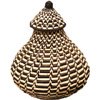
Those of you who know me well will already be familiar with my aversion to shopping (apart from the occasional dash into Wildlife for a bit of retail therapy after a particularly bad day). Here I shop at least once a day, every day. And I quite enjoy it.
Shopping involves a 20 minute walk past George the stork, along a murrum road, across a golf course, then murrum road into town. On the way I greet and am greeted by literally dozens of people, schoolchildren in their smart uniforms, women carrying improbably bulky loads on their heads, boda boys trying to persuade me I want a life on the back of their motorbike (interlude here – it seems incomprehensible that I would want to walk, I must have money as I’m muzungu, so why don’t I get a lift? When I’m out running I can see people watching mystified, then turning to the person next to them and saying “Oh, she’s taking exercise!”).
Some days I go to the dairy. This is about a further 10 minutes out of town, basically in a house. It’s a family business, making yoghurt and cheese (‘feta’, ‘gouda’, ‘cheddar’ and ‘mozzarella’ all tasting roughly the same). Then to the market where I cause great amusement trying to buy using only runyankore.
The availability of food is directly seasonal. The first mangoes are appearing on stalls, and the grasshoppers have just hatched(?). There are clouds of them flying around, and piles of them in the market. Some fresh and green and still with legs and wings, and others without (I think although I’m too squeamish to get close enough to know for sure) and fried brown.
And I usually end up buying a basket or two. They’re just great. And very cheap, ranging from 10p to 70p depending on size and shape. Irresistible.
Shopping involves a 20 minute walk past George the stork, along a murrum road, across a golf course, then murrum road into town. On the way I greet and am greeted by literally dozens of people, schoolchildren in their smart uniforms, women carrying improbably bulky loads on their heads, boda boys trying to persuade me I want a life on the back of their motorbike (interlude here – it seems incomprehensible that I would want to walk, I must have money as I’m muzungu, so why don’t I get a lift? When I’m out running I can see people watching mystified, then turning to the person next to them and saying “Oh, she’s taking exercise!”).
Some days I go to the dairy. This is about a further 10 minutes out of town, basically in a house. It’s a family business, making yoghurt and cheese (‘feta’, ‘gouda’, ‘cheddar’ and ‘mozzarella’ all tasting roughly the same). Then to the market where I cause great amusement trying to buy using only runyankore.
The availability of food is directly seasonal. The first mangoes are appearing on stalls, and the grasshoppers have just hatched(?). There are clouds of them flying around, and piles of them in the market. Some fresh and green and still with legs and wings, and others without (I think although I’m too squeamish to get close enough to know for sure) and fried brown.
And I usually end up buying a basket or two. They’re just great. And very cheap, ranging from 10p to 70p depending on size and shape. Irresistible.
Mark and Jan's VSO placement baseline assessment
For those insomniacs who aren't really sure what we're doing here..........
ASSESSMENT OF THE CONTINUING POTENTIAL FOR A DEPARTMENT OF FAMILY MEDICINE AND COMMUNITY PRACTICE AT MBARARA UNIVERSITY OF SCIENCE AND TECHNOLOGY – NOVEMBER 2006
Background
Uganda faces considerable health challenges;
50% of the population do not have access to clean water
Average life expectancy is 45
320 people (mostly children) die every day from malaria
One and a half million people are known to be living with HIV/AIDS
51% of the population are more than 5km from any health facility
1 in 200 women who get pregnant will die from a pregnancy related complication
Infant mortality is 87/1000
There is less than 1 doctor per 10,000 of the population
80% of the population live on less than $1 a day, 96% on less than $2.
The Health Sector Strategic Plan (2000-2005) envisaged a strengthening of Primary Care with most care delivered by Health Centres 1-4 (each level with more sophisticated infrastructure and staffing) rather than by District or Regional Hospitals. This is a sound plan. Part of the development of this strategy requires strengthening the medical presence in Health Centre 4s, to provide comprehensive primary care as well as effective intrapartum care and some emergency surgical services. It was to meet the demand for these Health Centre 4 Medical Officers that the Ministry of Health supported the creation of the two Ugandan Masters Courses in Family Medicine and Community Practice (one at Makerere and one in Mbarara).
There are many significant blocks to the successful delivery of effective Primary Care;
The Health Sector as a whole is under-resourced. Government spending on health is 8% of an already small Gross Domestic Product (GDP). A Save the Children Fund report recommends 12-15% of GDP funding to meet already stated objectives
Undergraduate medical training is still largely specialty hospital focussed, although Makerere has had a more community orientated programme since 2003
Most medical students are from Kampala and prefer to follow careers in Kampala
There are too few medical graduates. The three major teaching hospitals are struggling to fill their own intern posts. Only 33% of rural medical posts are filled
Well funded NGOs offer higher salaries and draw doctors away from the public sector
Collaboration between NGO and Government facilities is poor with many NGO programmes concentrating on the delivery of disease specific services for HIV/AIDS or TB. In practice, there is no concept of comprehensive primary care.
In the public sector the level of commitment among doctors is low. Many public sector doctors spend much of their working time in the private sector to boost their income
Doctors are reluctant to work in remote settings under difficult physical conditions many hours distant from their families
Poor remuneration at medical officer level makes recruitment difficult
Lack of career progression and career opportunities is de-motivating
There are no opportunities for continuing medical education or support
Accommodation and facilities in remote settings are poor
There are often inadequate levels of support staff
Supply of drugs and equipment are outside the control of the individual doctor and are at best sporadic
Lack of infrastructure for performing operations e.g. caesarian sections leads to deskilling of the doctor and thus a total loss of the service at HC4 level
Widespread corruption and theft of supplies further impedes service delivery and damages morale.
Mbarara Placement
We have been recruited by Mbarara University of Science and Technology (MUST) to help consolidate the Department of Family Medicine and Community Practice. This Department currently exists only on paper. Dr Vincent Batwala has managed the Masters Programme in Community Practice and Family Medicine under the auspices of the Community Health Department for several years.
Current issues facing the Programme in Family Medicine:
There is no Clinical Department. This is a vital pre-requisite for teaching postgraduate and undergraduate students in a clinical discipline
There is no office space
There are currently no members of staff in the department and no-one associated with the University has a background in Family Medicine
There is no budget
The curriculum needs to be rewritten to prioritise the learning needs of the students and the Health Sector’s demand for generalist practitioners
At present the students are regarded by their placement departments as an extra pair of hands – the educational component of their attachments is poor
Student assessment is burdensome and not tailored to the practice of Family Medicine
There are currently no students in the first two years of the course.
Minimum requirements for a successful department to be established;
A secure funding stream must be established
At least one and preferably two Ugandan lecturers with a Masters in Family Medicine should be appointed as soon as possible
A follow on VSO volunteer lecturer in Family Medicine should be appointed to begin before September 2007
The department will need an office, a library, IT equipment and furniture
There needs to be a clinical teaching base for students of Family Medicine. In the successful South African model, the Department of Family Medicine runs a generalist triage service for the emergency room and the outpatient department
Lecturers in Family Medicine should have a clinical service commitment of at least 2 days each week
The Course Curriculum needs to be rewritten to reflect the objectives of Comprehensive Primary Care Delivery in Uganda with an emphasis on the management of HIV/AIDS, TB and malaria as well as on the delivery of effective child and maternal health programmes
Traditional courses are unsuitable for this Masters programme. Students come from backgrounds with very different work experiences. The course should be flexible enough to meet individual learning needs. Course assessments should reflect this
A programme of continuing medical education (CME). This requires a commitment to resource and support graduates in order that they can undertake an annual minimum level of CME
Institutions that deliver excellent Primary Care and individuals who practice Primary Care to a high standard need to be identified and supported. Students will be placed at these sites in apprenticeship roles with a comprehensive programme of mentoring and supervision. This system will require funding of the supervisors and supervising institutions
3-5 students need to be recruited into each academic year.
In order to meet these targets the ongoing support and sponsorship of the Faculty of Medicine, MUST and the Ministry of Health (MoH) is essential.
The Faculty of Medicine and MUST will need to provide;
office space
funding for the Lecturer posts and
support for the establishment of a clinical department of Family Medicine.
The MoH will need to commit to the funding of;
Tuition fees
Government salaries whilst students are on the Masters Programme
Travel and subsistence grants for community placements
Special Medical Officer status with a salary enhancement for Masters graduates
Grants for continuing medical education for Level 4 Health Centre Medical Officers
A salary structure which reflects training, experience and length of service.
Jan Power and Mark Russell. November 2006
Sunday, November 19, 2006
The 'C' word
The VSO training session I found most interesting, and most demoralising, was given by a representative from Anticorruption Uganda. We’ve already mentioned our frustrations at the hospital in Mbarara where drugs are stolen from the pharmacy and reagents from the lab such that neither department is able to provide a service. Petra, working for the women’s cooperative manufacturing candles soaps and other products from lemon grass in Ntungamo, arrived to find that the chairwoman of the committee had stolen the lion’s share of their £3000 grant. Amber’s employing NGO gets paid for running fictitious workshops, as does Fabiens.
Foreign aid constitutes the largest sector in the Ugandan economy, with more than 50% of government income coming from donors. This is big business. Ambitious and greedy people go into politics and use their connections to set up or get involved in NGOs. They have access to salaries, cars and, via various scams, a criminal income. There are now 6000 NGOs working on HIV alone in Uganda. They compete, sometimes aggressively, for scarce resources. Because they are in direct competition with each other there is a disincentive to work collaboratively. There is no effective control over their policies and practices, so they rarely work with the same aims, and it seems even more rarely in line with overall government strategy. Result; ineffectiveness, chaos and duplication. This is just one area. The country is full of NGOs. There’s a part of me that thinks all the money should be directed through central government so that they can work effectively to a sensible strategy, and part of me that knows that would be even more hopeless as the money would simply disappear.
This form of entrepreneurialism is effectively modelled by president Museveni, his family, friends and political colleagues. Museveni and his family have stolen hundreds of millions of dollars from the Ugandan people. This is corrosive stuff. When his health minister Jim Muhwezi was found after a commission of enquiry to have stolen millions of dollars from the global fund (destined to help Uganda fight HIV, TB and malaria), Museveni protected him, refusing to sack him. Largely, it was suspected, because Muheza knew too much about Museveni’s dodgy dealings. His own corrupt and some say murderous habits mean Museveni has a strong incentive to stay in power for life to evade investigation and accountability for his record - what democracy there is here may be no more than a sham. The Global Fund (worth $100m to Uganda) has been suspended since July 2005, and has just been suspended again until next year at the earliest.
Nearly everybody steals or expects things to be stolen. Corrupt practices hamper sensible business development and investment because the playing field is biased and unpredictable. Funds don’t reach their targets so infrastructure is poorly developed; the roads are bad, electricity unreliable (the national electricity company is run by Museveni’s daughter).
On Thursday we met Paddy and Mike Martin from Marazion. They’ve been coming to Uganda for 5 years and have invested heavily in the construction and supplying of a primary school north of Kampala. They are now switching their energies elsewhere after a catalogue of abuses, with building supplies stolen, school equipment stolen, and teachers barely turning up for work.
Our dilemma then, is, do you engage with or disengage from corrupt organisations? VSO’s view seems to be one of constructive engagement. The ‘muzungu’ sticks the course, models a European work ethic, insists on transparent practices, is appalled by any hint of corruption and thereby educates people about good governance. Our experience is that this is a fairly ineffective approach. The corruption becomes more covert or the muzungu is unwelcome. Judith, who was posted to the corrupt pharmacy department at Mbarara hospital, was ignored and not spoken to for her first 3 months here until she decided she should get a job elsewhere. I favour a process which sets high standards for the partner organisations, maybe even aiding them with short term placements at start up to regularise issues of accounting and governance. VSO’s ‘bums on seats’ approach to maximising placement numbers seems to us to be counterproductive in this situation.
Ugandans love to talk politics and most are fed up with Museveni. However, alongside that discontent many still have vivid memories of 20 years of mayhem, brutality and bloodshed from a few years after independence in 1962 to Museveni’s overthrow of Obote in 1986. During those years most administrators and civil servants were murdered, expelled from or fled the country. Museveni has brought relative stability though little in the way of economic development or the regeneration of civil society. Uganda is a fertile country with plentiful food and some valuable natural resources, equatorial sunshine, plenty of rain, the Nile for energy and now apparently some oil reserves but there seems to be no way out of the present predicament short of another bloody revolution at some point down the line.
We enjoyed the thought advertised in the press recently of a prize for the African president who voluntarily stands down after no longer than 2 terms, having left the country in a better state than when he arrived. The prize was a pension of $5m pa for life. Local people quipped that that’s probably as much as Museveni steals in an average day!!!...........
Foreign aid constitutes the largest sector in the Ugandan economy, with more than 50% of government income coming from donors. This is big business. Ambitious and greedy people go into politics and use their connections to set up or get involved in NGOs. They have access to salaries, cars and, via various scams, a criminal income. There are now 6000 NGOs working on HIV alone in Uganda. They compete, sometimes aggressively, for scarce resources. Because they are in direct competition with each other there is a disincentive to work collaboratively. There is no effective control over their policies and practices, so they rarely work with the same aims, and it seems even more rarely in line with overall government strategy. Result; ineffectiveness, chaos and duplication. This is just one area. The country is full of NGOs. There’s a part of me that thinks all the money should be directed through central government so that they can work effectively to a sensible strategy, and part of me that knows that would be even more hopeless as the money would simply disappear.
This form of entrepreneurialism is effectively modelled by president Museveni, his family, friends and political colleagues. Museveni and his family have stolen hundreds of millions of dollars from the Ugandan people. This is corrosive stuff. When his health minister Jim Muhwezi was found after a commission of enquiry to have stolen millions of dollars from the global fund (destined to help Uganda fight HIV, TB and malaria), Museveni protected him, refusing to sack him. Largely, it was suspected, because Muheza knew too much about Museveni’s dodgy dealings. His own corrupt and some say murderous habits mean Museveni has a strong incentive to stay in power for life to evade investigation and accountability for his record - what democracy there is here may be no more than a sham. The Global Fund (worth $100m to Uganda) has been suspended since July 2005, and has just been suspended again until next year at the earliest.
Nearly everybody steals or expects things to be stolen. Corrupt practices hamper sensible business development and investment because the playing field is biased and unpredictable. Funds don’t reach their targets so infrastructure is poorly developed; the roads are bad, electricity unreliable (the national electricity company is run by Museveni’s daughter).
On Thursday we met Paddy and Mike Martin from Marazion. They’ve been coming to Uganda for 5 years and have invested heavily in the construction and supplying of a primary school north of Kampala. They are now switching their energies elsewhere after a catalogue of abuses, with building supplies stolen, school equipment stolen, and teachers barely turning up for work.
Our dilemma then, is, do you engage with or disengage from corrupt organisations? VSO’s view seems to be one of constructive engagement. The ‘muzungu’ sticks the course, models a European work ethic, insists on transparent practices, is appalled by any hint of corruption and thereby educates people about good governance. Our experience is that this is a fairly ineffective approach. The corruption becomes more covert or the muzungu is unwelcome. Judith, who was posted to the corrupt pharmacy department at Mbarara hospital, was ignored and not spoken to for her first 3 months here until she decided she should get a job elsewhere. I favour a process which sets high standards for the partner organisations, maybe even aiding them with short term placements at start up to regularise issues of accounting and governance. VSO’s ‘bums on seats’ approach to maximising placement numbers seems to us to be counterproductive in this situation.
Ugandans love to talk politics and most are fed up with Museveni. However, alongside that discontent many still have vivid memories of 20 years of mayhem, brutality and bloodshed from a few years after independence in 1962 to Museveni’s overthrow of Obote in 1986. During those years most administrators and civil servants were murdered, expelled from or fled the country. Museveni has brought relative stability though little in the way of economic development or the regeneration of civil society. Uganda is a fertile country with plentiful food and some valuable natural resources, equatorial sunshine, plenty of rain, the Nile for energy and now apparently some oil reserves but there seems to be no way out of the present predicament short of another bloody revolution at some point down the line.
We enjoyed the thought advertised in the press recently of a prize for the African president who voluntarily stands down after no longer than 2 terms, having left the country in a better state than when he arrived. The prize was a pension of $5m pa for life. Local people quipped that that’s probably as much as Museveni steals in an average day!!!...........
Bed with a view
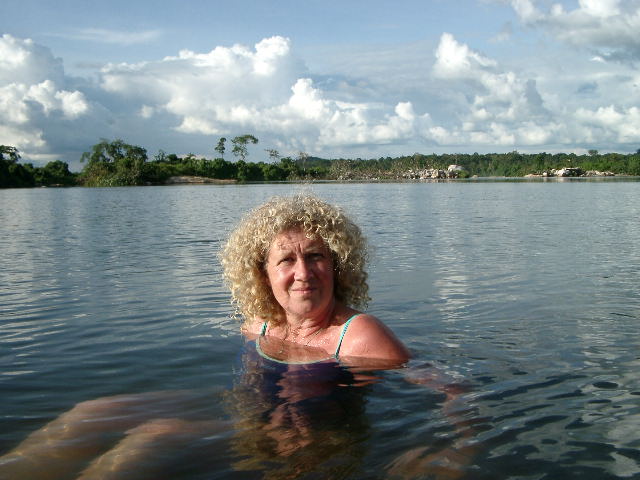
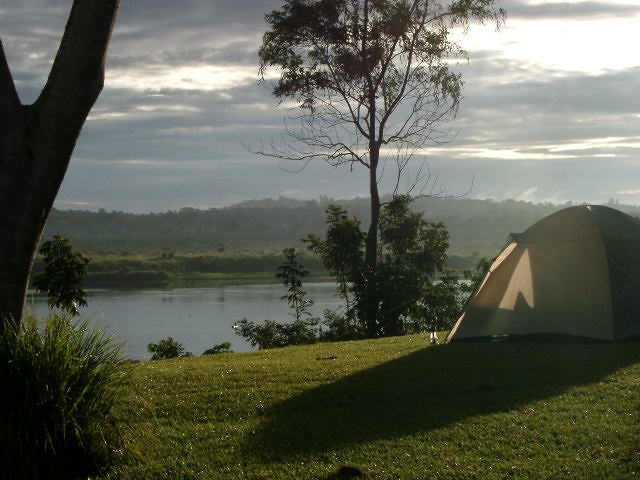
Soon after waking this morning I unzipped the tent flap and peered from my comfortable bed across the still waters of the Nile just as the first sunlight reflected across it. A fish eagle took off from its treetop perch swirled in the air and dove into the water. Flocks of snowy egrets swooped low over the river and cormorants cruised along inches above the river dipping down over the thundering rapids. Two otters paddled beneath us. (Jan – I initially thought they were crocodiles and nearly dropped my cup of tea, brought to us in the tent by a very nice waiter, as I’d been happily swimming yards from the spot minutes earlier). This was much better than telly!!!
We spent the weekend with Frouke and Petra exploring the source of the Nile where it leaves Lake Victoria at Jinja. Saturday night’s idyllic campsite was at The Haven, a small encampment 10 miles north of the busy colonial town of Jinja. The Haven sits high on the bank of the Nile, above a set of its famous grade 5 rapids, as the river courses through lush green countryside. There are yet more goat shed style buildings here, beautifully decorated and finished, so they provided plenty of inspiration for our next venture.
There is no hint of development in the surrounding area. Small hamlets of brick and mud huts melt into the matoke and sugar cane plantations – the land is heavily cultivated but not in a manner we would recognise. From a distance it appears like an open woodland. Up close the trees are a mix of productive trees including many laden with impossibly large Jack fruits.
We’ll be going back and we are also definitely going to go over the rapids in a raft!
We spent the weekend with Frouke and Petra exploring the source of the Nile where it leaves Lake Victoria at Jinja. Saturday night’s idyllic campsite was at The Haven, a small encampment 10 miles north of the busy colonial town of Jinja. The Haven sits high on the bank of the Nile, above a set of its famous grade 5 rapids, as the river courses through lush green countryside. There are yet more goat shed style buildings here, beautifully decorated and finished, so they provided plenty of inspiration for our next venture.
There is no hint of development in the surrounding area. Small hamlets of brick and mud huts melt into the matoke and sugar cane plantations – the land is heavily cultivated but not in a manner we would recognise. From a distance it appears like an open woodland. Up close the trees are a mix of productive trees including many laden with impossibly large Jack fruits.
We’ll be going back and we are also definitely going to go over the rapids in a raft!
VSO in-country training

November is green grasshopper (nsenene) season in Uganda so you'll often come across hordes of people out collecting these edible delicacies for selling and frying. The grasshoppers are particularly attracted to lights at night. We still haven't been brave enough to try them....
The 12 VSO volunteers in our cohort re-congregated at the Lwesa Conference Centre a few kilometres outside Kampala for a week of debriefing and political and cultural training 6 weeks into our placements. The high stodge institutional food and solitary TV for entertainment provided the background for our varied and various grumblings. VSOs overriding priority - as a result of donor pressure - is volunteer numbers rather than quality of placements. Half its funding comes from the Department for International Development and it is set various targets to meet. So when we complain of jobs that don’t bear any resemblance to job descriptions (like ours) or jobs with unsupportive employers (crap housing or failure to pay the subsistence grants) or jobs with organisations that are blatantly corrupt, the response from VSO sometimes seemed a bit half-hearted…..
In order to keep morale up, we both skived off several of the sessions as the ones we attended, though interesting, tended to be of a Ugandan style lecture based format and could easily hit 2 hours long without a break. My attention span is a maximum 20 minutes in that kind of setting. Instead we hit the shopping centres, finding ourselves wandering dazed and drooling through the huge and shiny shopping malls of downtown Kampala. We’ve bought loads of books to satisfy Jan’s thirst for reading.
Kampala is a medium sized, grotty, smog choked traffic jam of a city so it was good to discover some of its nicer aspects. We ate really well! First with Mya and Alastair, then at the Café Roma, Le Petit Bistro and finally at the Speke resort. We also spent a comfortable afternoon (and then most of Jan’s birthday) lounging in the luxurious environs of the Speke resort. This is a deluxe hotel complex on the shore of Lake Victoria with possibly the nicest 50 metre swimming pool ever built.They also had 2 storey goat sheds in their grounds!!
In order to keep morale up, we both skived off several of the sessions as the ones we attended, though interesting, tended to be of a Ugandan style lecture based format and could easily hit 2 hours long without a break. My attention span is a maximum 20 minutes in that kind of setting. Instead we hit the shopping centres, finding ourselves wandering dazed and drooling through the huge and shiny shopping malls of downtown Kampala. We’ve bought loads of books to satisfy Jan’s thirst for reading.
Kampala is a medium sized, grotty, smog choked traffic jam of a city so it was good to discover some of its nicer aspects. We ate really well! First with Mya and Alastair, then at the Café Roma, Le Petit Bistro and finally at the Speke resort. We also spent a comfortable afternoon (and then most of Jan’s birthday) lounging in the luxurious environs of the Speke resort. This is a deluxe hotel complex on the shore of Lake Victoria with possibly the nicest 50 metre swimming pool ever built.They also had 2 storey goat sheds in their grounds!!
Wednesday, November 15, 2006
Bwindi Community Health Centre


A WEEK AT BWINDI COMMUNITY HEALTH CENTRE
Bwindi Community Health Centre was established by American Missionaries Scott and Carol Kellerman in 2002, to bring healthcare to the Batwa Pigmy Community. The Batwas are traditional hunter gatherers displaced from their natural forest home by the incursion of agriculturalists and by the creation of the national parks. These people now live in extreme poverty with no culture of food growing and no means of earning an income. Childhood mortality is 60%. Scott has created a charitable foundation that works with the Batwa people to provide housing, sanitation, water and schooling as well as providing health services.
The health centre has in patient facilities for adults and children, a busy outpatient department, an antenatal clinic as well as an immunisation programme. In-patients are mainly children with severe malaria or with malnutrition.
Paul and Vicky are two VSO volunteers who have been working at the centre since Easter this year. They have worked hard to introduce professional standards of care with clear protocols for the management of the common conditions. There are regular teaching sessions and staff meetings. The service is currently run by a medical officer, 2 clinical officers (nurse practitioner equivalent) and 5 nurses. There are basic laboratory, Xray and ultrasound facilities and hopes to open a surgical unit next year. Proactive HIV screening starts on December 1st (world AIDS day) and access to ARVs will come soon.
The annual running cost is currently about $200,000 of which half comes from charging the non Batwa users of the service and half comes from funds raised by Scott mainly in the USA. (Currently TB treatment, feeding of malnourished children and HIV testing are free. The Batwa community have a completely free service).
Scott is now spending half the year in Bwindi and half the year raising funds in America.
Compared to the other services we have had experience of since we’ve been in Uganda this service is excellent. (Remember it is common for there to be no drugs, no IV fluids, routine laboratory tests unavailable, poor medical care, non-existent nursing care).
We spent our week either on the ward or in the outpatient department. On Friday we joined Vicky and Paul at an outreach clinic in a Batwa village, 40 minutes from Bwindi. King, the manager of one of the local tourist camps brought a few of his staff for crowd control and to act as interpreters and we rattled through 80 people with an assortment of problems including coughs, colds and fevers.
We were well looked after in the guest house at the centre and had the good company not only of Paul and Vicky and the permanent staff at the centre but also of a couple of Danish medical students and Steve from Lake Tahoe who has been working as a general handyman here for the last 3 months.
Paul and Vicky are facing many challenges. Good timekeeping, regular ward rounds and teaching sessions and good record keeping depend on their continued presence and tend to slip when they leave Bwindi.
BCHC has up to now had a hand to mouth existence. It is very dependent on funds raised by Scott. When Scott isn’t around cash-flow can be problematic. Paul has taken to schmoozing with tourists visiting the national park to raise funds for important new projects (very successfully). A VSO volunteer is coming for 3 months in the new year to establish a formal accounting and budgeting system. Paul is also setting up a ‘Friends of Bwindi’ group, who he hopes will make regular financial contributions and provide regular income. One of the financial challenges is the extent to which the centre develops as a mini hospital. The current limited x-ray and ultrasound facilities are expensive to run and of dubious priority given the low immunisation rate, poor access to antenatal care and high incidence of the big killers – malnutrition, malaria, TB and HIV.
The establishment of a surgical unit will impose further financial strain on the centre. Whilst it makes sense to offer caesarian sections when maternal mortality is currently so high and the transfer time to the nearest surgical facility is 2 hours it will involve large revenue costs with surgical, anaesthetic and nursing staff as well as equipment and supplies. Paul worries that high cost interventions that help the few will limit the organisations capacity to make low cost interventions that help many more people such as community education, vaccination, antenatal care and family planning (a familiar tension in all health systems).
We were enormously impressed by the health centre and by the work Paul and Vicky are doing. This is a well organised, corruption free project. Within the confines of a low resource setting the health centre is providing extremely high quality care. Paul has identified improvements in maternal and child healthcare, and reducing the very high mortality rates as one of their most important priorities. In order to achieve this they have appointed a midwife, Evelyn, to provide antenatal and intrapartum care. She is great. Competent and kind, she is proving very successsful at persuading women to attend for antenatal care where several simple interventions can be made to dramatically reduce maternal and child mortality. Specifically, the treatment and prophylaxis of malaria and worms reduces anaemia and the likelihood of death from Post Partum Haemorrhage. Screening and treatment for HIV and syphilis (both probably with around 10% prevalence) reduces congenital transmission, and tetanus vaccination prevents neonatal tetanus. She and Paul are developing protocols for identifying women who are at higher risk of running into problems in pregnancy or labour to target them for more intensive antenatal care and to try to persuade them to attend the centre for delivery. She is seeing about twenty new women a week in a weekly antenatal clinic.
Large family sizes are the norm. This is entirely understandable. Women expect that at least half of their children will die before the age of five and the role of children in the family is to collect water, herd goats and look after younger siblings. Access to family planning is poor. Prolonged and obstructed labours in isolated homes are very common and cause large numbers of stillbirths and maternal deaths.
It has previously been a struggle to encourage women to attend the centre for delivery but Evelyn’s popularity is changing this. As word is spreading amongst the local women, her workload is increasing rapidly. Evelyn is on call 24hrs per day for 25 days then has 5 days off, when labour ward and antenatal clinic are covered by the only other nurse with any obstetric experience. In the week we were there she was up most of the night every night, and looked completely exhausted. There is an urgent need for a second midwife. It would cost approximately £150 per month to cover her salary and other costs. Before we left the UK some of our friends asked us to identify a small project that they could contribute to directly. This could well be a good one. Check out Bwindi’s website at http://www.bchc.ug/ or mail us for more information.
PS I had my first Ugandan snake encounter in the bathroom in Bwindi. Just turned and noticed the snake sitting on a ledge a foot away from where I was brushing my teeth. Made me jump and I had to be rescued by the security guard who whacked it with a very long stick!
Bwindi Community Health Centre was established by American Missionaries Scott and Carol Kellerman in 2002, to bring healthcare to the Batwa Pigmy Community. The Batwas are traditional hunter gatherers displaced from their natural forest home by the incursion of agriculturalists and by the creation of the national parks. These people now live in extreme poverty with no culture of food growing and no means of earning an income. Childhood mortality is 60%. Scott has created a charitable foundation that works with the Batwa people to provide housing, sanitation, water and schooling as well as providing health services.
The health centre has in patient facilities for adults and children, a busy outpatient department, an antenatal clinic as well as an immunisation programme. In-patients are mainly children with severe malaria or with malnutrition.
Paul and Vicky are two VSO volunteers who have been working at the centre since Easter this year. They have worked hard to introduce professional standards of care with clear protocols for the management of the common conditions. There are regular teaching sessions and staff meetings. The service is currently run by a medical officer, 2 clinical officers (nurse practitioner equivalent) and 5 nurses. There are basic laboratory, Xray and ultrasound facilities and hopes to open a surgical unit next year. Proactive HIV screening starts on December 1st (world AIDS day) and access to ARVs will come soon.
The annual running cost is currently about $200,000 of which half comes from charging the non Batwa users of the service and half comes from funds raised by Scott mainly in the USA. (Currently TB treatment, feeding of malnourished children and HIV testing are free. The Batwa community have a completely free service).
Scott is now spending half the year in Bwindi and half the year raising funds in America.
Compared to the other services we have had experience of since we’ve been in Uganda this service is excellent. (Remember it is common for there to be no drugs, no IV fluids, routine laboratory tests unavailable, poor medical care, non-existent nursing care).
We spent our week either on the ward or in the outpatient department. On Friday we joined Vicky and Paul at an outreach clinic in a Batwa village, 40 minutes from Bwindi. King, the manager of one of the local tourist camps brought a few of his staff for crowd control and to act as interpreters and we rattled through 80 people with an assortment of problems including coughs, colds and fevers.
We were well looked after in the guest house at the centre and had the good company not only of Paul and Vicky and the permanent staff at the centre but also of a couple of Danish medical students and Steve from Lake Tahoe who has been working as a general handyman here for the last 3 months.
Paul and Vicky are facing many challenges. Good timekeeping, regular ward rounds and teaching sessions and good record keeping depend on their continued presence and tend to slip when they leave Bwindi.
BCHC has up to now had a hand to mouth existence. It is very dependent on funds raised by Scott. When Scott isn’t around cash-flow can be problematic. Paul has taken to schmoozing with tourists visiting the national park to raise funds for important new projects (very successfully). A VSO volunteer is coming for 3 months in the new year to establish a formal accounting and budgeting system. Paul is also setting up a ‘Friends of Bwindi’ group, who he hopes will make regular financial contributions and provide regular income. One of the financial challenges is the extent to which the centre develops as a mini hospital. The current limited x-ray and ultrasound facilities are expensive to run and of dubious priority given the low immunisation rate, poor access to antenatal care and high incidence of the big killers – malnutrition, malaria, TB and HIV.
The establishment of a surgical unit will impose further financial strain on the centre. Whilst it makes sense to offer caesarian sections when maternal mortality is currently so high and the transfer time to the nearest surgical facility is 2 hours it will involve large revenue costs with surgical, anaesthetic and nursing staff as well as equipment and supplies. Paul worries that high cost interventions that help the few will limit the organisations capacity to make low cost interventions that help many more people such as community education, vaccination, antenatal care and family planning (a familiar tension in all health systems).
We were enormously impressed by the health centre and by the work Paul and Vicky are doing. This is a well organised, corruption free project. Within the confines of a low resource setting the health centre is providing extremely high quality care. Paul has identified improvements in maternal and child healthcare, and reducing the very high mortality rates as one of their most important priorities. In order to achieve this they have appointed a midwife, Evelyn, to provide antenatal and intrapartum care. She is great. Competent and kind, she is proving very successsful at persuading women to attend for antenatal care where several simple interventions can be made to dramatically reduce maternal and child mortality. Specifically, the treatment and prophylaxis of malaria and worms reduces anaemia and the likelihood of death from Post Partum Haemorrhage. Screening and treatment for HIV and syphilis (both probably with around 10% prevalence) reduces congenital transmission, and tetanus vaccination prevents neonatal tetanus. She and Paul are developing protocols for identifying women who are at higher risk of running into problems in pregnancy or labour to target them for more intensive antenatal care and to try to persuade them to attend the centre for delivery. She is seeing about twenty new women a week in a weekly antenatal clinic.
Large family sizes are the norm. This is entirely understandable. Women expect that at least half of their children will die before the age of five and the role of children in the family is to collect water, herd goats and look after younger siblings. Access to family planning is poor. Prolonged and obstructed labours in isolated homes are very common and cause large numbers of stillbirths and maternal deaths.
It has previously been a struggle to encourage women to attend the centre for delivery but Evelyn’s popularity is changing this. As word is spreading amongst the local women, her workload is increasing rapidly. Evelyn is on call 24hrs per day for 25 days then has 5 days off, when labour ward and antenatal clinic are covered by the only other nurse with any obstetric experience. In the week we were there she was up most of the night every night, and looked completely exhausted. There is an urgent need for a second midwife. It would cost approximately £150 per month to cover her salary and other costs. Before we left the UK some of our friends asked us to identify a small project that they could contribute to directly. This could well be a good one. Check out Bwindi’s website at http://www.bchc.ug/ or mail us for more information.
PS I had my first Ugandan snake encounter in the bathroom in Bwindi. Just turned and noticed the snake sitting on a ledge a foot away from where I was brushing my teeth. Made me jump and I had to be rescued by the security guard who whacked it with a very long stick!
Thursday, November 02, 2006
Examiners
This week we found ourselves in the role of examiners for the two graduating students on the Masters Programme in Family Medicine. Over the last fortnight they've done MCQs, written papers, clinical case exams and vivas in each of Surgery, Medicine, Paediatrics and O&G. A huge burden for them and something we hope to change. They've both done OK and probably better than I would have done!
Fortunately for us the external examiner, Atai, came from the departmentof Family Medicine in Kampala. She's a bright and dynamic Ugandan woman who has been the Head of Department there for 3 years. Now, finally, after several long conversations with her, we've begun to understand what's expected of us and can start to make plans.
These revolve around establishing a proper department of Family Medicine, with office space and lecturing staff and some form of clinical component to it's activity. Initially we'll be looking at creating a presence in the outpatient department of the University Hospital here. Many of the patients self refer to outpatients even though they have problems that can be dealt with easily in Primary Care (chest infections, hypertension, malaria). Given that Primary Care isn't well established some form of Primary Care clinic as a first stop seems sensible and works elsewhere... Needless to say it'll have to go through a lot of committees.....
Fortunately for us the external examiner, Atai, came from the departmentof Family Medicine in Kampala. She's a bright and dynamic Ugandan woman who has been the Head of Department there for 3 years. Now, finally, after several long conversations with her, we've begun to understand what's expected of us and can start to make plans.
These revolve around establishing a proper department of Family Medicine, with office space and lecturing staff and some form of clinical component to it's activity. Initially we'll be looking at creating a presence in the outpatient department of the University Hospital here. Many of the patients self refer to outpatients even though they have problems that can be dealt with easily in Primary Care (chest infections, hypertension, malaria). Given that Primary Care isn't well established some form of Primary Care clinic as a first stop seems sensible and works elsewhere... Needless to say it'll have to go through a lot of committees.....
Subscribe to:
Posts (Atom)